Presumed 1st calendar year hybrid of Red-backed × Woodchat Shrike (Lanius collurio × senator) in Pyrenees (NE Iberia)
Summary
In July 2024, a juvenile shrike was trapped at a ringing station in the Pyrenees (NE Spain). Despite the specimen’s general resemblance to a Red-backed Shrike Lanius collurio, some atypical features caught the ringer’s attention: they suggested a hybrid Red-backed × Woodchat Shrike Lanius collurio × senator, as described in the literature. The most important features were (1) a pale-ochre area at the base of some primaries, (2) an extensive pale pattern on the outer rectrices, (3) pale-beige scapulars and median coverts, and (4) pale lower back and rump with some pale beige uppertail coverts. This paper provides a detailed description of the specimen, supported by photographs. After an in-depth analysis and comparison with documented hybrids, the authors conclude that the bird’s appearance strongly suggests a presumed hybrid Red-backed × Woodchat Shrike. This is the first reported case of such a presumed hybrid in 1st calendar year plumage unrelated to its progenitors.
Background
Review of hybridisation cases
Woodchat Shrike Lanius senator (hereafter WS) is the only shrike known to hybridise with Red-backed Shrike Lanius collurio (hereafter RBS) (Lefranc 2022). Their breeding ranges overlap across south-western and central Europe, and the first documented hybrid was already collected near Neuchâtel, Switzerland in May 1865 — a bird so puzzling it was given its own name, Lanius dubius (Depierre 1886 in Lefranc 2022). Records accumulated rapidly thereafter, particularly in France, where 17 mixed pairs were documented between 1985 and 2020 (Fely 1993; Lallemant & Riols 2007; Maas et al. 2013; Curry 2018; Lefranc 2022). In all 17 French cases the female was WS — in 13 the male was RBS, in four the male was himself a hybrid — and seven pairs produced young. This consistent asymmetry, with female WS always pairing with male RBS or male hybrids, likely reflects the relative scarcity of female WS in contact zones. Beyond France, further individual breeding events and hybrid-phenotype adults have been documented at scattered sites across Europe and Iberia; these records are summarised in Table 1.
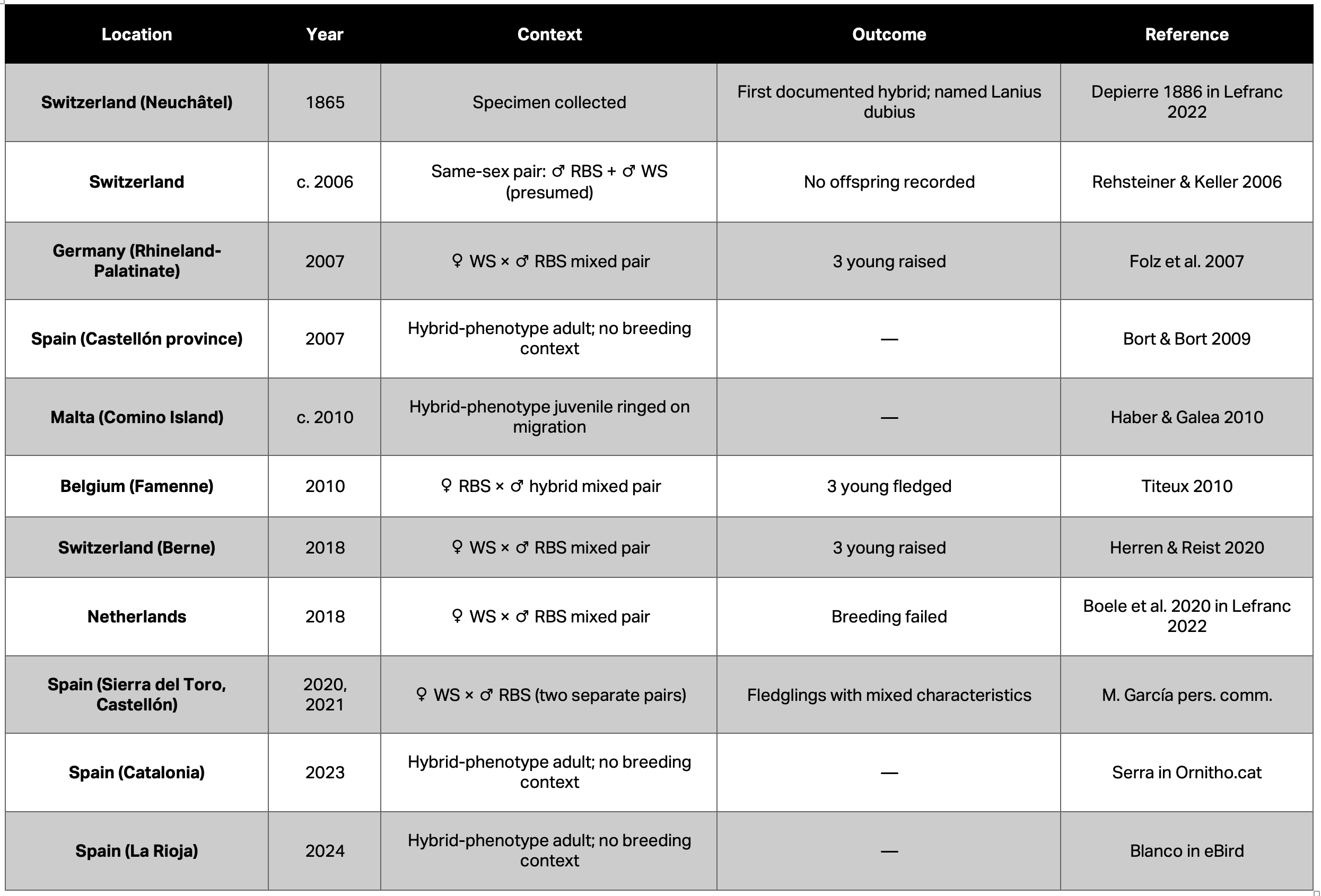
Table 1. Summary of previously reported hybridisation events.
All existing records of 1st calendar year hybrids are linked to known mixed pairs, either through direct study or through observations of juveniles being fed by their parents. Up until now, there are no documented cases of 1st calendar year hybrids identified independently of their progenitors. Can such birds be confidently identified in the absence of the parental pair?
Identification of 1st calendar year hybrid Red-backed × Woodchat Shrikes
Most bird identification handbooks provide no information on 1st calendar year RBS × WS hybrids. Ringing manuals are no exception; only the Identification Guide to Birds in the Hand by Demongin (2016) describes the juvenile as “similar to WS with ‘frosted’ appearance, primaries and secondaries dark brown tipped white, but without white mirror at the base of primaries or clear pale area on scapulars.” A handful of publications do document the plumage of young hybrids from known mixed pairs (Folz et al. 2007; Herren & Reist 2020; Maas et al. 2013; García & Ibáñez in eBird), and the available evidence is synthesised below by feature, drawing on photographs from these sources (Photos 5–9).
Primary patch. Pure RBS lack any pale area at the base of the primaries, while WS show a conspicuous rufous-buff primary patch. Among documented 1cy hybrids, most individuals described by Folz et al. (2007), Herren & Reist (2020), and Maas et al. (2013) did not show a primary patch, or it was not recorded. However, the more WS-like juveniles from Sierra del Toro showed a reduced ochre patch at the primary bases, smaller than in a pure WS (Photo 9). The primary patch thus appears to be inconsistently expressed in 1cy hybrids, its presence and extent likely reflecting the degree of WS ancestry.
Outer rectrices. In pure RBS, the outer rectrices (r5–r6) show variable pale patches and a faint dusky subterminal band. In WS, white patches near the tip are extensive and the subterminal band is poorly defined or absent. Among documented hybrids, pale or extensive white patches on the outer tail feathers were noted in more WS-like juveniles from Germany (Folz et al. 2007), Switzerland (Herren & Reist 2020, Photo 7), and Sierra del Toro. Birds from the French mixed pairs that were more RBS-like showed only a broad white terminal band on the outer rectrices (Maas et al. 2013). The tail pattern of 1cy hybrids therefore spans a continuum from near-RBS to near-WS.
Scapulars and median coverts. In pure RBS, scapulars and median coverts are typically reddish-brown with a dark subterminal band; in WS they are white or buff-white. Pale scapulars and/or pale median coverts were the most consistently recorded hybrid feature across all sources: they were present in the more WS-like juveniles from Germany (Photo 5), Switzerland (Photo 7), and Sierra del Toro (Photo 9), and in at least one bird from the Frotey-lès-Vesoul brood and from Confracourt (Maas et al. 2013). The intensity of the pale tone is generally less buff-white than in pure WS, and some siblings from the same brood showed no pale scapulars at all (Photos 6, 8), confirming that this feature is variable even within a single family.
Rump, lower back, and uppertail coverts. The rump is pale in WS, contrasting with the back and uppertail coverts, while in RBS it is generally concolorous, though a slightly paler rump can occasionally occur. Pale rump and/or pale uppertail coverts were noted in WS-like juveniles from Germany (Photos 5, 6), Switzerland (Photo 7), and Sierra del Toro (Photo 9). The pattern is variable: in some birds the entire rump and uppertail covert tract is pale, while in others only the shorter uppertail coverts appear pale, creating a bicoloured pattern.
Head pattern. Pure RBS typically show a brownish or reddish head, though greyer individuals occur. WS juveniles usually have a pale grey crown. A notably pale or greyish crown was recorded in some hybrid individuals from Germany (Photo 5) and Switzerland, and in the Sierra del Toro birds. However, other siblings from the same broods showed an unremarkable brownish head (Photos 6, 8), confirming that head colour alone is an unreliable feature.
General plumage tone and structure. In all documented cases, 1cy hybrids showed a combination of RBS-like and WS-like features rather than a uniform intermediate appearance, and variation within the same brood was pronounced. Several birds closely resembled pure RBS, differing only in subtly paler scapulars or a slightly broader pale tail patch. Crucially, no single feature was sufficient to identify a bird as a hybrid; hybrid status was inferred from the co-occurrence of multiple WS-like traits in an otherwise RBS-like bird. Structure — head shape, bill depth, and wing formula — consistently pointed toward RBS in those birds documented in the hand.

The case of the Vall Fosca Shrike
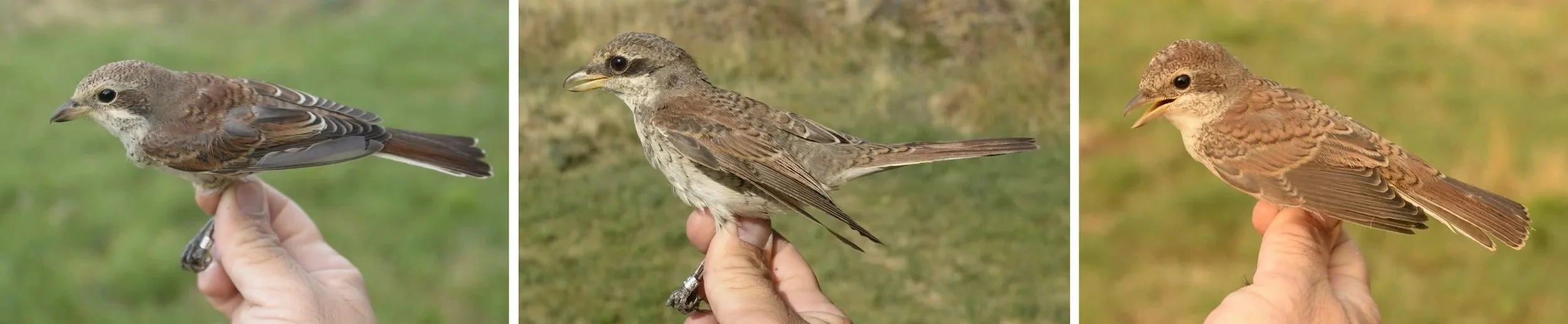
On 26 July 2024, a 1st calendar year shrike, presumed RBS× WS hybrid was trapped at La Torre de Capdella, Vall Fosca, Lleida Pyrenees, Catalonia, northeastern Spain. The bird was ringed at the Aguiró bird ringing station as part of the MigraVallFosca programme, which monitors bird migration across the Pyrenees (Josa & Castilló 2020). This station is a regular passage site for RBS, particularly 1st calendar year birds: between 2010 and 2024, 814 individuals were ringed. By contrast, only three WS — all 1st calendar year — have been ringed there. RBS is an abundant breeder in the Pyrenean area, while WS does not breed there, though it is a common breeder elsewhere in Catalonia (Franch et al. 2021). In northern Iberia, the two species can breed in sympatry in some areas (Hernández 1994, Garrido 2020). The Balearic Woodchat Shrike Lanius senator badius is a regular spring vagrant in Catalonia, with no records of 1st calendar year birds or of summer and autumn occurrences in the region (Gutiérrez et al. 2005, López & Clavell 2009, Gil et al. 2016, Alvarez 2021).
Because 1st calendar year RBS show considerable individual variation, establishing whether a bird falls outside the normal range of the species requires a large reference dataset. For this study, we examined and photographically documented variation in general coloration and in the pattern of tail feathers, tertials, coverts, scapulars, crown, throat, supercilium, and ear coverts in 750 1st calendar year RBS trapped at the same station between 2010 and 2024. The morphology of the Vall Fosca Shrike was compared with hundreds of images from this reference dataset and with descriptions in the literature (Svensson 2023; Shirihai & Svensson 2018; Ottenby Bird Observatory 2015; Van Duivendijk 2010; Van Duivendijk 2024; Jenni & Winkler 2020; Lefranc 2022; Worfolk 2000; Bryson & Paijmans 2023; Demongin 2016; Blasco 2022), as well as with photographs of documented hybrids (Folz et al. 2007; Herren & Reist 2020; Maas et al. 2013; García & Ibáñez in eBird), included here with kind permission of the photographers.
Throughout this paper the bird is referred to as the “Vall Fosca Shrike”, after the valley where it was trapped. Overall, it closely resembled a RBS in structure — head shape, bill, primary projection, and wing formula — and in many aspects of its plumage. However, four features had not been recorded in any of the 750 reference RBS and closely matched descriptions of RBS × WS hybrids in the literature: (1) a pale-ochre area at the base of the inner primaries, (2) an extensive pale pattern on the outer rectrices, (3) pale-beige scapulars and median coverts, and (4) a pale lower back and rump with pale-beige uppertail coverts.
Below we describe in detail the features of the Vall Fosca Shrike, comparing each with RBS, WS, and other documented hybrids. Features that fell clearly within the normal range of the 750 reference RBS are described briefly at the end of this section. Primaries (p) are numbered in ascending order from the outermost inward, and rectrices (r) are numbered outward from the central pair, following Svensson (2023).
Primary patch. A subtle pale-ochre area is present at the bases of the six inner primaries, being most distinct — appearing whitish-buff — at the base of p5. No such pale area is present in 1st calendar year RBS. In contrast, WS exhibit a conspicuous rufous-buff primary patch, though this is (almost) absent or tinged rufous in Balearic Woodchat Shrike. The primary pattern of the Vall Fosca Shrike thus differs from both pure RBS and pure WS and is intermediate in extent. Among documented RBS × WS hybrids, only the more senator-like individuals from Sierra del Toro showed a comparable ochre area at the primary bases (Photo 9); most other documented hybrids lacked this feature entirely.
Outer rectrices. The outermost tail feathers, r6 and r5, display a broad white patch at the tip, with a subterminal black band that curves parallel to the tip. Where this band crosses the rachis, it forms a sharp spike reaching toward the tip and partially intruding into the white patch before curving back proximally. In RBS, the extent of terminal pale patches on the outer rectrices is variable, and the dusky subterminal band — when present — may occasionally form a rachis spike, but it is generally limited in extent. In WS, the outer rectrices have extensive white patches near the tip with a poorly defined or absent subterminal band. The pattern of r5 and r6 in the Vall Fosca Shrike is intermediate, combining a broad white patch (as in WS) with a well-defined subterminal band forming a pronounced rachis spike (unlike most WS). None of the 750 reference RBS in this study showed such extensive white patches on r5 and r6. One hybrid documented by Herren & Reist (2020) (Photo 7) showed a closely comparable pattern, with broad white patches and a central rachis spike on r5; in other documented hybrids the tail pattern could not be assessed from available photographs.
Scapulars. The scapulars closest to the tertials are pale-beige with a dark subterminal band, in marked contrast with the reddish-brown scapulars typical of RBS (which show the same subterminal band but in rufous or brown tones). In WS, these scapulars are white. The pale-beige tone of the Vall Fosca Shrike is less buff-white than in WS but strikingly paler than any scapular recorded in the 750 reference RBS. Pale scapulars of similar tone have been documented in several hybrid individuals (Photos 5, 7, 9), though some siblings from the same broods showed no pale scapulars at all (Photos 6, 8).
Median coverts. The background colour is pale beige with a dark subterminal band, contrasting with the reddish-brown lesser coverts. In RBS the median coverts are typically red-brown and similar in tone to the scapulars, back, and other coverts; some individuals may show slightly paler fringes, but nothing approaching the tone seen in the Vall Fosca Shrike. In WS, the median coverts are white with a dark terminal band. The pale-beige median coverts of the Vall Fosca Shrike are consistent with WS influence and were also recorded in documented hybrids (Photos 7, 9).
Rump and lower back. The lower back and rump are pale, contrasting with the back and mantle. In RBS the rump is generally concolorous with the back and uppertail coverts, though a slightly paler rump can rarely occur. In WS the rump is pale and contrasts clearly with the back. The Vall Fosca Shrike shows a pale lower back and rump more consistent with WS, and a pale rump has been noted in several documented hybrids (Photos 5, 6, 7, 9).
Uppertail coverts. The shorter uppertail coverts are largely pale-beige with a dark subterminal band, contrasting with the redder mantle. The largest uppertail coverts, however, show the typical RBS red-brown coloration, creating a bicoloured pattern within the tract — a pattern closely resembling that of WS, and distinct from the uniform red-brown of RBS. Pale uppertail coverts have been documented in several hybrid individuals (Photos 5, 6, 7, 9).
Head. The crown is largely pale grey with a creamy hue and dark marks, contrasting with the reddish-brown mantle. Only a few red-brown feathers fringe the crown, and the boundary between the paler crown and the redder nape is clearly defined. RBS show considerable variability in head coloration — typically brown or reddish, but occasionally greyish-brown — yet the pale grey crown of the Vall Fosca Shrike was not matched by any of the 750 reference RBS. WS also show variable head coloration, with pale grey being most frequent. Comparable grey head tones have been noted in several documented hybrids (Photos 5, 6, 7, 9).
Mantle and upper back. These are reddish-brown, as in RBS, but several feathers show paler subterminal areas with only a faintly marked subterminal band. This is consistent with a degree of WS influence: some documented hybrids also show pale mantle feathers (Photos 5, 9), while others do not (Photo 8).
The remaining features of the Vall Fosca Shrike fell within the normal range of RBS and are described briefly below for completeness.
Structure and biometrics. Head shape, bill size and shape, primary projection (100% of tertial length), wing formula (emarginations on P3 and P4; P2 = P5), and overall body structure are all consistent with RBS and incompatible with WS. Biometric measurements — wing 95 mm, 3rd primary 72 mm, tarsus 23.7 mm, weight 30.7 g — fall within the range for both RBS and WS but are too small for Balearic Woodchat Shrike (Svensson 2023). In WS the head is proportionally larger and more rounded, and the bill is deeper and more angular.
Flight feathers and coverts. The secondaries and tertials are similar in pattern and colour to RBS, less dark than in WS (which typically shows uniform dark tertial centres). Primary coverts are similar in both RBS and WS. The greater coverts resemble those of RBS, though showing somewhat more variable patterning; in WS a paler subterminal band on the greater coverts is typical.
Underparts. The belly and flanks show the chevron-marked pattern with a cream-pale background typical of 1cy RBS, without the heavier or differently toned barring occasionally seen in WS.
Discussion
The long primary projection, wing formula, and overall plumage rule out Brown Shrike, Isabelline Shrike, and Turkestan Shrike, all rare vagrants in Spain (Worfolk 2000, Shirihai & Svensson 2018, Svensson 2023). Biometric measurements and wing formula are compatible with both RBS and WS, but several structural and plumage features exclude WS, including the elongated head, thin bill, lack of white patches on the primaries, tertial pattern, and extensive red-brown colouration on the mantle. The Balearic Woodchat Shrike is similar to WS but differs in having slightly larger size, a stronger bill, head sides and flanks that are sometimes slightly darker with heavier dark barring, cream-white at the base of the primaries absent or replaced by rufous on the outer webs (Shirihai & Svensson 2018), and darker uppertail coverts (Van Duivendijk 2024). The head structure, bill shape, wing size, and certain plumage features of the Vall Fosca Shrike further exclude Balearic Woodchat Shrike as a possibility. This leaves two main hypotheses: it is either a RBS × WS hybrid or a RBS displaying numerous unusual traits.
Thus, we conclude that a careful analysis of the plumage is essential to detect presumed 1st calendar year hybrids. In RBS, the upperparts vary considerably in tone, ranging from rufous to greyish and from dark to pale (Worfolk 2000). Variability has also been documented in head pattern, throat, ear coverts, supercilium, tertials, scapulars, and general coloration (Bryson & Paijmans 2023), as well as in the pattern of the outer tail feathers (Svensson 2023). However, several traits observed in the Vall Fosca Shrike are not typical of RBS including 1) the pale area at the base of the primaries, 2) the pattern of the outer tail feathers with an extensive pale patch, 3) pale-beige scapulars, 4) pale-beige median coverts, and 5) pale uppertail coverts. While a pale lower back and rump occur occasionally in RBS, it remains an uncommon trait.
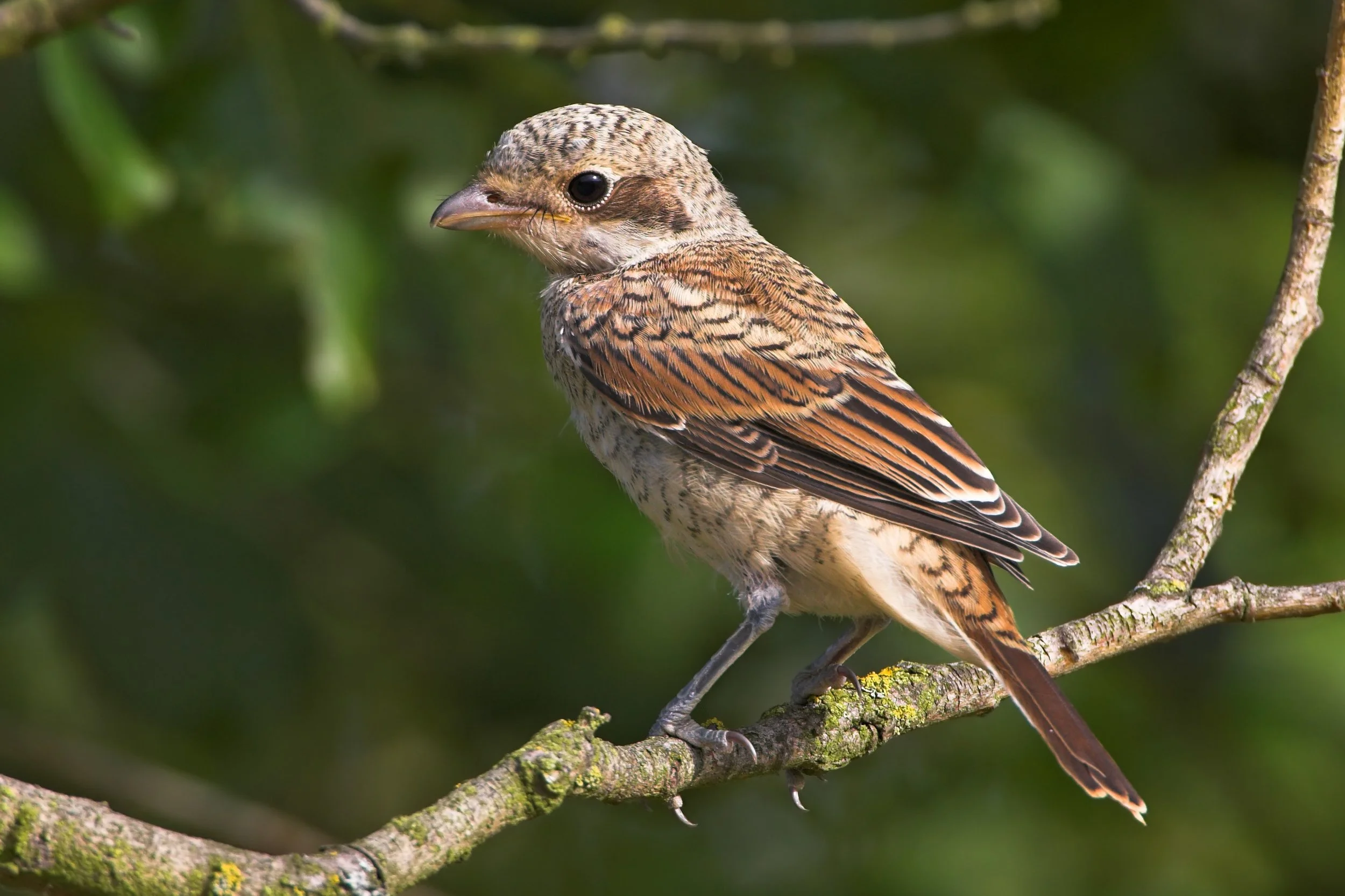
Plate 5. Red-backed × Woodchat shrike Lanius collurio × senator. Dorsheim, Rhineland-Palatinate, Germany. July 2007. Mathias Schäf. Pale grey head, pale scapulars, some pale uppertail coverts.
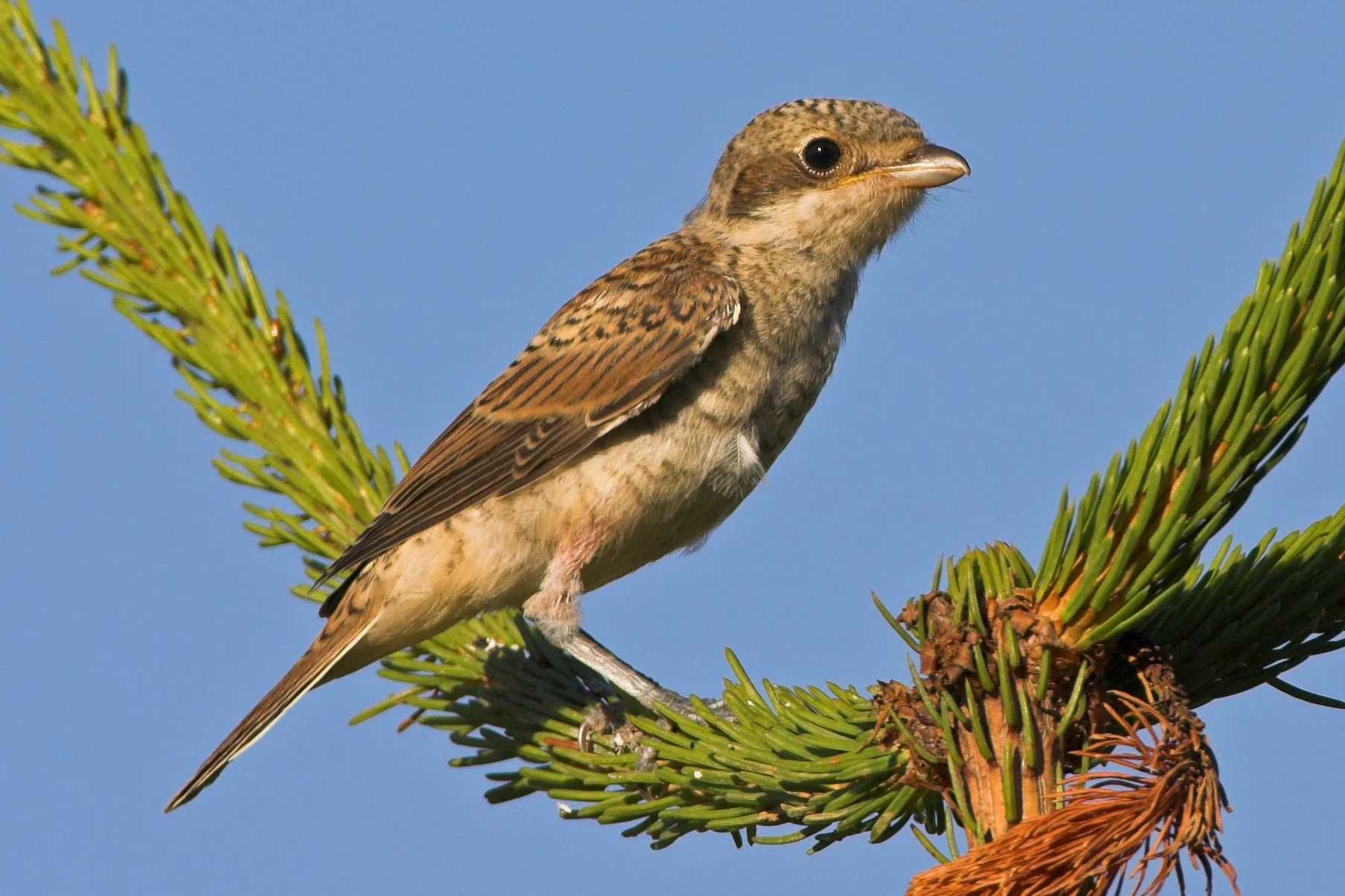
Plate 6. Red-backed × Woodchat shrike Lanius collurio × senator. Same clutch as the juvenile in Plate 5. Resembling a Red-backed Shrike, having perhaps just slightly paler feathers on crown and scapulars. Both juveniles are hybrid siblings from a mixed pair, as reported by Folz et al. (2007).
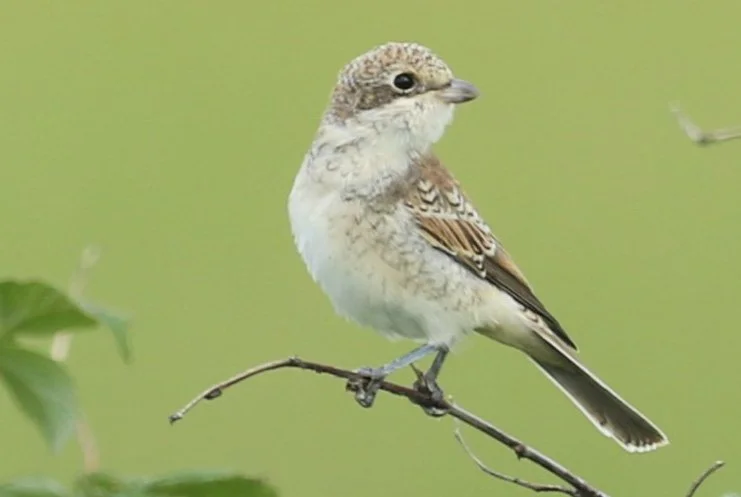
Plate 7. Red-backed × Woodchat shrike Lanius collurio × senator. Berne, Switzerland. August 2018. Bernard Herren. Pale patches on the scapulars and greater coverts, more extensive pale area on the outer tail feathers and a subterminal dark band present, some pale uppertail coverts.
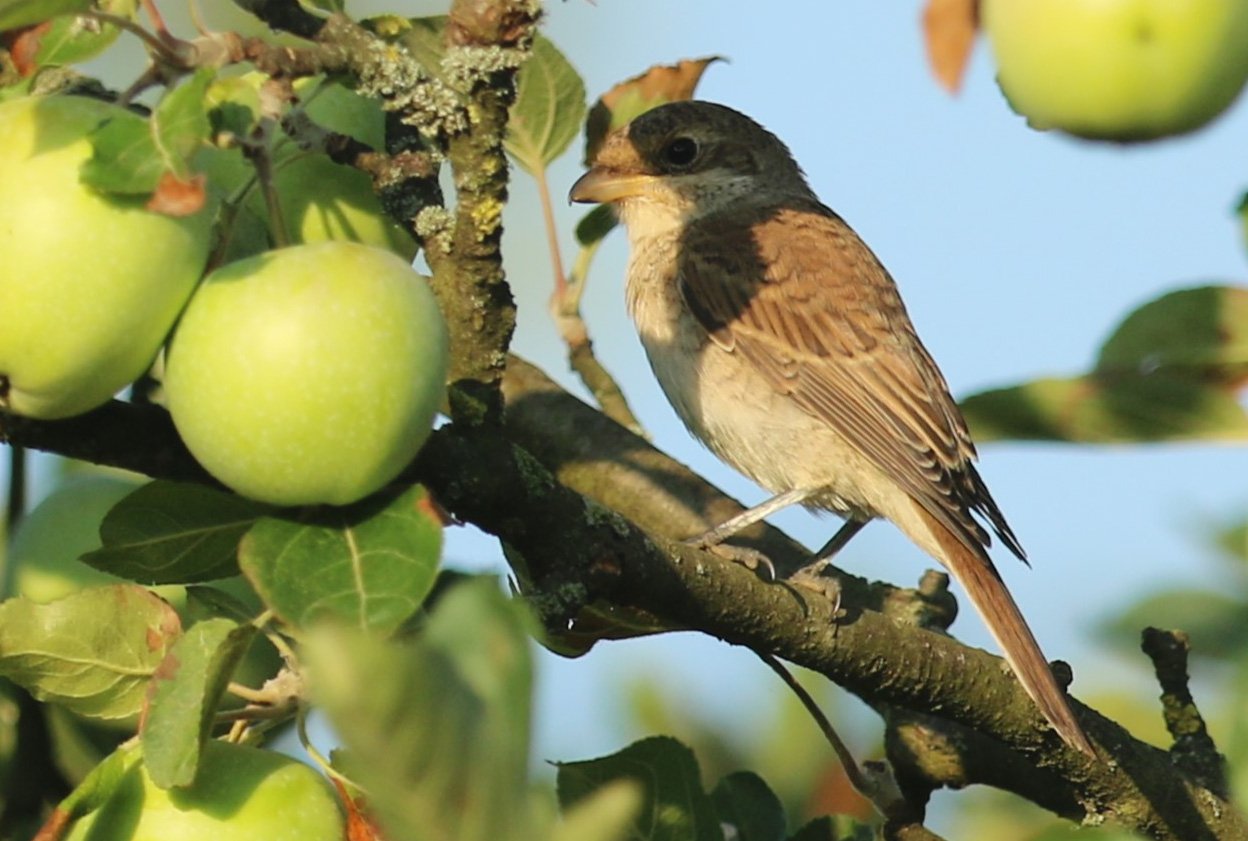
Plate 8. Red-backed × Woodchat shrike Lanius collurio × senator. Same clutch as bird in Plate7, as reported by Herren & Reist (2020).
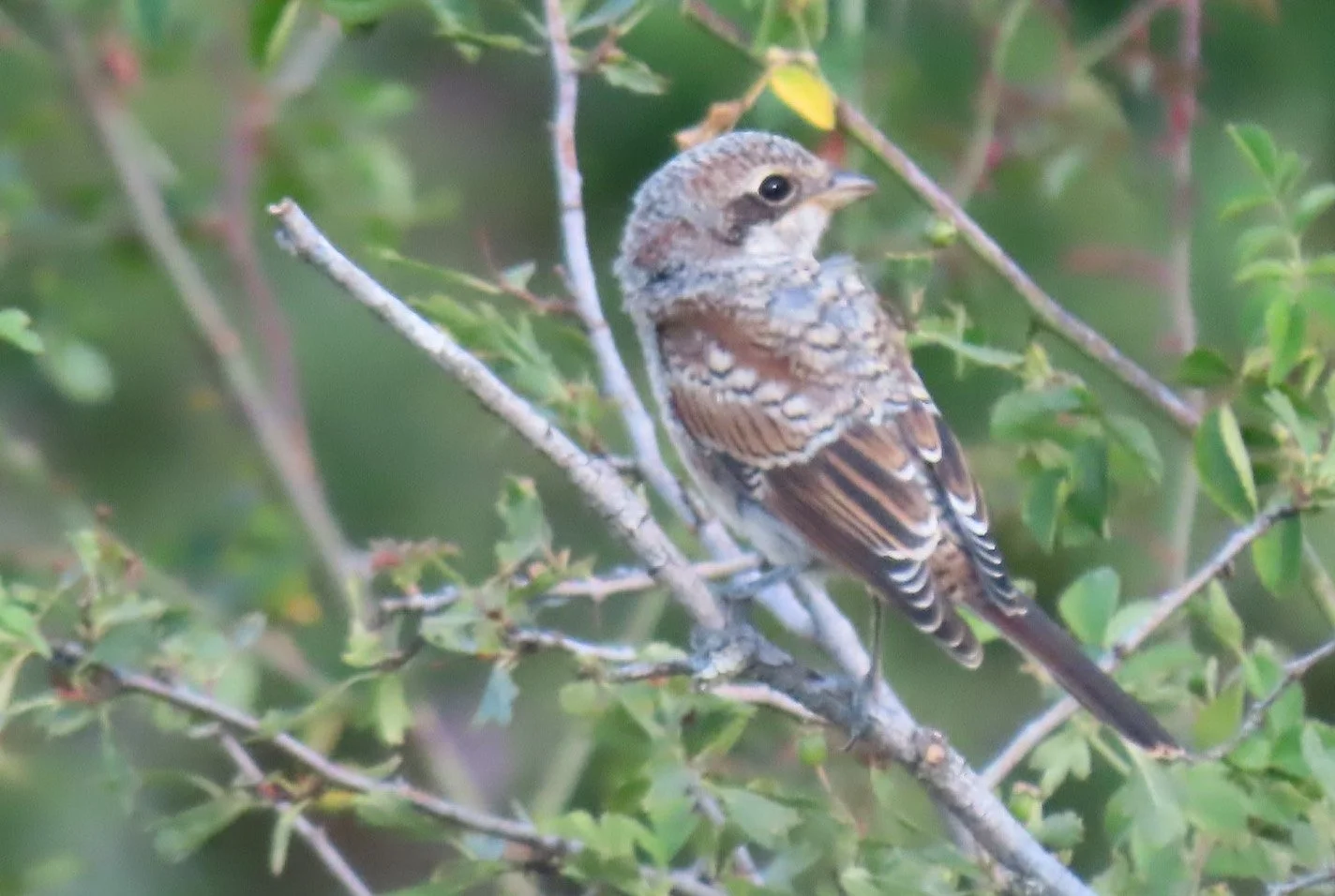
Plate 9. Red-backed × Woodchat Shrike Lanius collurio × senator. 21 July 2021. Sierra del Toro, Castelló, Spain. Marta Ibáñez. This young bird is closer in appearance to Woodchat Shrike, as it shows pale scapulars and median coverts, a pale area on the back with reddish-brown feathers restricted to the sides, and a pale rump and crown. The reddish-brown tertial pattern, together with the relatively small, elongated head and thin bill, is more consistent with Red-backed Shrike. This bird also exhibited an extremely reduced primary patch.
The Vall Fosca Shrike exhibits a combination of traits absent in RBS, resembling other documented hybrids such as those described in Folz et al. (2007), Herren & Reist (2020), Maas et al. (2013), and the Sierra del Toro case (García & Ibáñez in eBird). Although caution is warranted — hence the use of ‘presumed’ — in the absence of genetic confirmation, the authors propose that the Vall Fosca Shrike is a hybrid of RBS × WS. To our knowledge, this is the first 1st calendar year RBS × WS hybrid identified independently of any known mixed pair.
A potential source of confusion not yet discussed in the context of RBS × WS hybrids concerns vagrant Asiatic shrikes that occur on migration in Iberia. Isabelline Shrike Lanius isabellinus and Brown Shrike Lanius cristatus are rare but regular autumn vagrants in W Europe, and 1st calendar year individuals of both species can resemble an RBS with anomalous plumage. However, several features reliably separate them from an RBS × WS hybrid. Isabelline Shrike typically shows more uniform sandy-buff upperparts, a broader and more distinct pale supercilium, a rounded head profile, finer flank barring, and a stronger pale base to the bill. Brown Shrike is darker and warmer brown above, with a distinctly rufous rump and flanks, and lacks the pale scapular and covert pattern expected in a WS-influenced hybrid. Neither species shows the combination of a pale primary patch with pale scapulars and pale median coverts that characterises more WS-like hybrids. The long primary projection and wing formula inherited from the RBS parent further separate any such hybrid from both Isabelline and Brown Shrike (Worfolk 2000; Shirihai & Svensson 2018). A careful assessment of primary projection, wing formula, bill shape, and upperpart patterning should allow confident separation in most cases, particularly when the bird is examined in the hand.
The future frequency of RBS × WS hybridisation in south-western Europe is likely to increase, driven by ongoing changes in the breeding distributions of both species. According to the second European Breeding Bird Atlas (Keller et al. 2020), RBS has expanded substantially southward into Iberia in recent decades, colonising warmer, more thermophilus habitats in areas historically dominated by WS. This range expansion is bringing the two species into contact over a broader and growing geographic front. Conversely, WS has retracted from parts of its former range in central Europe — including France and Germany, where most mixed pairs have so far been documented — while expanding in the south-western Mediterranean. The net effect of these trends is to reduce the well-established contact zone in central France while creating a new and expanding one across Iberia, where the two species now co-occur regularly during the breeding season in some northern and central areas (Garrido 2020). Under this scenario, the proportion of RBS × WS hybrids passing through Iberian ringing stations during autumn migration could grow significantly over the coming decades and, given the species dispersal and migration ecologies, it might also at least maintain the hybrid’s occurrence in Europe. The present record, from a station in the Pyrenean foothills, is consistent with this expectation. We encourage ringers and field observers working in south-western Europe to document any shrike showing anomalous features during the August–September migration period, and to collect genetic samples from trapped individuals where possible, as molecular confirmation would greatly strengthen future assessments of hybrid occurrence rates.
Acknowledgements
Thomas Kuppel for his help in preparing this paper. Bernard Herren, Matias Schäf, Santi Catchot, Javier Blasco-Zumeta, Marta Ibañez and Marc Illa for kindly allowing the use of these photos. Manolo García for the information of Sierra del Toro hybrids. Lucía Soliño for the help in English version. Bernat Espluga and Marc Illa for their comments and suggestions, which greatly improved the final text.
References
Alvarez-Cros, C., Burgas, A., Franch, M., Fuentes, M. A., Gálvez, M. García, M., Gil-Velasco, M., Illa, M., Larruy, X., Ollé, X. 2021. Ocells rars a Catalunya Informe del Comitè. Rare birds in Catalonia. Report of the Catalan Avifauna Committee 2015, 2016 & 2017. Butlletí del CAC 2: 42-61.
Bernhard, H., Erwin, R. 2020. Brood of a Red-backed Shrike Lanius collurio with a Woodchat Shrike L. senator in the canton of Berne. Ornithologischer Beobachter 117: 66–70.
Blasco-Zumeta, J., Heinze, G.M. 2022. Atlas de identificación de las aves continentales de la Península Ibérica. Tundra Ediciones, Castellón.
Bort, J., Bort, J.L. (Coord.). 2009. Anuario Ornitológico de Castellón 2007, Vol. 5. http://www.internatura.org/aocs
Bryson, U., Paijmans, D.M. 2023. Red-backed Shrike (Lanius collurio) Linnaeus, 1758 on its non-breeding grounds: comparative biometrics,moult data and criteria to determine age and sex. Namibian Journal of Environment 7 D: 1-19.
Curry, D. 2018.Observation d’un couple mixte de Pie-grièche écorcheur (Lanius collurio) / Pie-grièche à tête rousse (Lanius senator) en Bresse. Revue Scientifique Bourgogne-Franche-Comté Nature. 28-2018. 102-105.
Demongin, L. (2016). Identification guide to birds in the hand. Cambridge University Press; Cambridge: 2016.
eBird. 2024. https://ebird.org
Fely, F. 1993.Un cas d’hybridation entre une Pie-grièche écorcheur et une Pie-grièche à tète rousse Lanius collurio × Lanius senator en Dordogne. Le Courbageot 14 (1993): 45-49.
Folz, H-G, Vollmar, B., Schmidt, V., Schäf, M. and Dietzen, C. 2007. Eine Mischbrut zwischen Neuntöter Lanius collurio und Rotkopfwürger L. senator in Rheinland-Pfalz. Limicola 21 (3): 218-232.
Garrido-Bautista, J. (2020). Alcaudón común – Lanius senator. En: Enciclopedia Virtual de los Vertebrados Españoles. López, P., Martín, J., Moreno-Rueda, G. (Eds.). Museo Nacional de Ciencias Naturales, Madrid. http://www.vertebradosibericos.org/
Gil-Velasco, M., Burgas, A., García, M., Illa, M., Larruy, X., Ollé, À. & Franch, M. (2016) Ocells rars a Catalunya. Informe del Comitè Avifaunístic de Catalunya 2012, 2013 i 2014. Butlletí del CAC 1: 32-43.
Gutiérrez, R., Arcos, J.M., Clavell, J., Copete, J.L., Martí-Aledo, J., Sales, S. & Clarabuch, O. 2005. Ocells rars a Catalunya 2004. Anuari d’Ornitologia de Catalunya 2001: pp. 348-368. Barcelona: Institut Català d’Ornitologia.
Haber, G., Galea, R. (2010). Lanius hybrid ringed on Comino Island. Il-Merill 32: 35.
Hernández, Á. (1994). Selección de hábitat en tres especies simpátricas de alcaudones (Real, Lanius excubitor L., Dorsirrojo, Lanius collurio L. y Común, Lanius senator L.): segregación interespecífica. Ecología, 8: 395-413.
Franch, M., Herrando, S., Anton, M., Villero, D. & Brotons, L. 2021. Atles dels ocells nidificants de Catalunya: Distribució i abundància 2015–2018 i canvi des de 1980. Institut Català d’Ornitologia / Cossetània Edicions. Barcelona.
Jenni, L., Winkler, R. 2020. Moult and Ageing of European Passerines. Second edition. London.
Josa, P. Castilló, J. 2020. MigraVallFosca: Resultados del seguimiento de la migración posnupcial en una estación de anillamiento en el Pirineo. Revista de anillamiento 39: 6-15.
Keller, V., Herrando, S., Vorisek, P., Franch, M., Molina, B., Sirkiä, P., Lehikoinen, A., Lindström, Å., Green, M., Teufelbauer, N., Wahl, J., Jacoby, K., Herrmann, M., Klvana, P., Strus, I., Lorrilliere, R., Rabosee, D., Copete, J.L., Grangé, J.L., Nilsson, L., Meissner, W., Portolou, D., Chodkiewicz, T., Chylarecki, P., Jiguet, F., Schmid, H., Zbinden, N. & Bräunlich, A. 2020. European Breeding Bird Atlas 2: Distribution, Abundance and Change. European Bird Census Council & Lynx Edicions. Barcelona.
Kryukov, A. P., and S. P. Gureev. 1997. New data on interrelations of Red-backed and Brown shrikes (Lanius collurio and L. cristatus, Aves) in the zone of sympatry. Russian Journal of Zoology 4: 537-544.
Lallemant, J.J., Riols, R. 2007. Observations sur un couple mixte de Pie-grièche écorcheur x Pie-grièche à tête rousse dans le puy-de-Dôme, en juin-juillet 2207.
Lefranc, N. 2022. Shrikes of the World. Helm. Bloomsbury Publishing. Ireland.
López, F. & Clavell, J. 2009. Ocells rars a Catalunya. Informe del Comitè Avifaunístic de Catalunya. 2005, 2006, 2007 i 2008. In: Anton, M. (ed.). 2009 Anuari d’Ornitologia de Catalunya. 2008. pp.305-331. Barcelona: Institut Català d’Ornitologia.
Maas, S., Besançon, T., Bouzendorf, F., Lefranc, N. 2013 À propos de l’hybridation des Pies-grièches écorcheur Lanius collurio et à tête rousse L. senator. Ornithos 20: 137–148.
Nikolov, B. 2003. Presumed hybrid between Red-backed Shrike and Lesser Grey shrike in Bulgaria. British Birds 96. September 2003.
Ottenby Bird Observatory. 2015. Ringers DigiGuide. Lanius collurio. www.ringersdigiguide.ottenby.se consulted 05 Dec 2020.
Titeux N. (2010). Nidification d’un hybride Pie-grièche écorcheur × Pie grièche à tête rousse, Lanius collurio x L. senator. In Jacob J.-P., Dehem C., Burnel A., Dambiermont J-L., Fasol M., Kinet T., van der Elst D. & Paquet J.-Y., Atlas des oiseaux nicheurs de Wallonie 2001-2007. Gembloux, Aves et Région Wallonne, Série « Faune-flore-habitats » n°5: 401.
Shirihai, H., Svensson, L. 2018. Handbook of the Western Paleartic Birds. Volume I. Passerines Larks to Warblers. London.
Svensson, L. 2023. Identification Guide to European Passerines. Fifth revised edition. Stockholm.
Rehsteiner, U., Keller, A. 2006. Neuntöter-Mánnchen Lanius collurio «verpaart» mit einem mutmasslichen Rotkopfwürger-Männchen L.senator. Der Ornithologische Beobachter 103: 3-6.
Van Duivendijk, N. 2010. Advanced Bird ID Guide: the Western Palearctic. New Holland, London.
Van Duivendijk, N. 2024. Aves de Europa: Identificación de todas las especies y plumajes. Lyns Nature Books, Barcelona.
Herren, B. & Reist, E. 2020. Brood of a Red-backed Shrike Lanius collurio with a Woodchat Shrike L. senator in the canton of Berne. Ornithologischer Beobachter 117: 66–70.
Worfolk, T. 2000. Identification of red-backed, isabelline and brown shrikes. Dutch Birding 22: 323-362,